

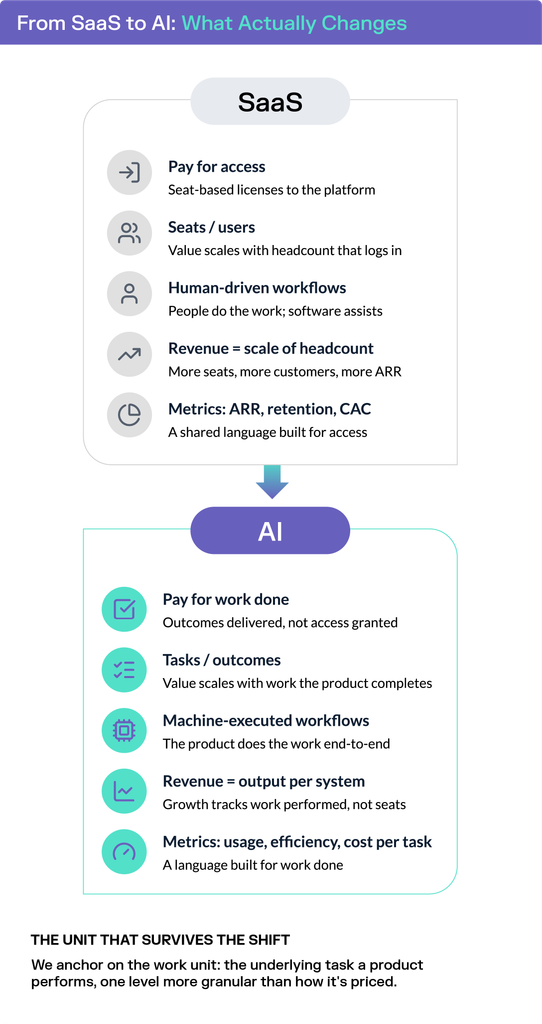
For two decades, the SaaS business model has been the gold standard of software. The model is simple and intuitive: sell seat-based access to the platform, expand seats within an enterprise, and add more customers. Metrics like ARR, retention, and gross margin gave founders and investors a shared language to understand performance.
But AI has scrambled that language. Software is no longer just the interface on which work is done. It does the work, delivering outcomes instead of access. It is this promise that has produced an era with some of the fastest revenue growth the industry has ever seen.
The challenge is that the industry is still trying to measure these businesses with the old SaaS playbook, and taking growth at face value. An AI-native company can race to tens of millions in ARR while churn quietly builds under the surface, waiting for renewal. The operating leverage AI promises can dissolve as headcount costs and reappear as compute. Spectacular growth and durable growth are not the same, and traditional SaaS metrics can’t tell them apart.
What’s Changing
In a traditional SaaS business, value tracks cleanly with the number of seats and their willingness to pay. If a customer continues to pay for seats, even with minimal usage, they are almost certainly still getting value from the platform access.
With AI, the core value proposition has fundamentally shifted. When the product does the work, revenue and seats no longer tell you whether it is being relied on. What matters more is whether the product is actually being used to do meaningful work, whether customers continue to trust its work over time, and whether it is genuinely replacing human effort.
To measure this consistently across the gamut of AI pricing models, we anchor on the work unit: the underlying task a product performs, one level more granular than how it happens to be priced. If a company prices per seat, the work unit may be the under of workflows executed. If it prices on AI credits, the work unit may be the underlying tokens consumed. Whatever the pricing wrapper, the work unit is agnostic, measuring the underlying work that is done through the product.
The Problem of Latent Churn
One of the biggest shifts with AI products is how usage behaves after adoption. It’s possible for an AI company to show strong revenue growth while underlying usage is weakening. On paper, the business looks healthy. In reality, it’s quietly being replaced.
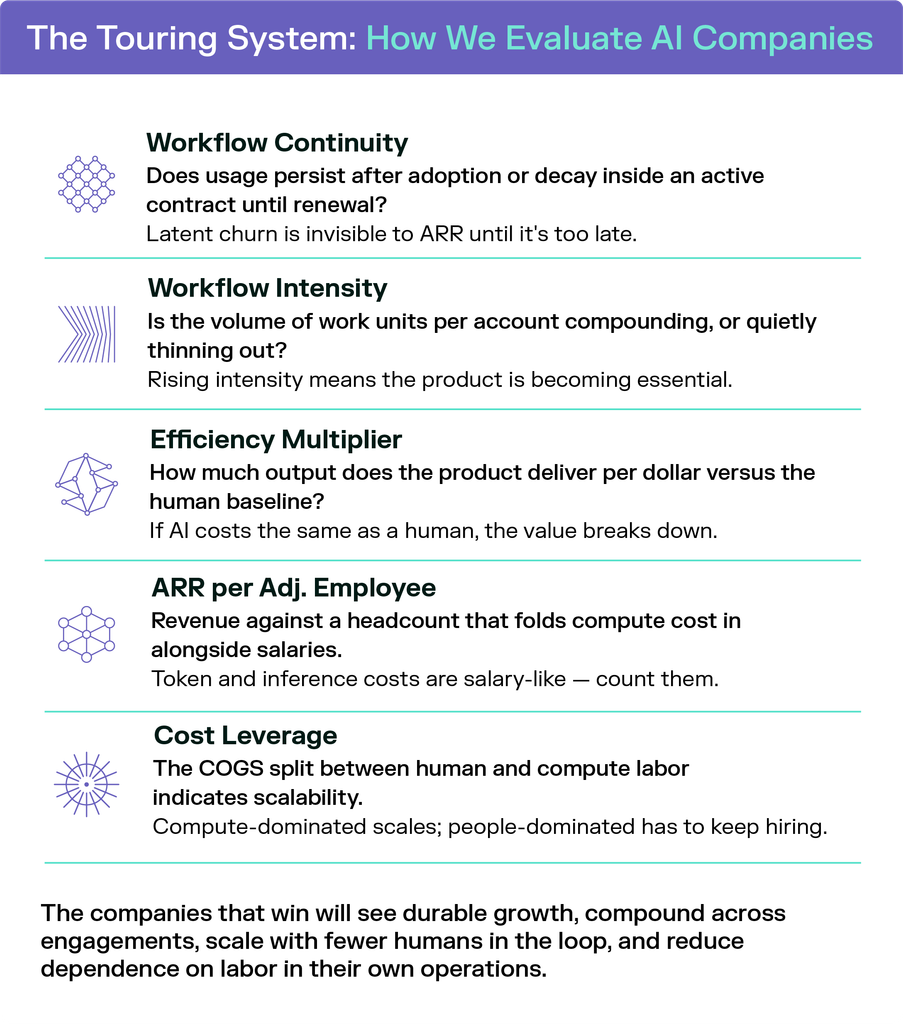
A customer might start off highly engaged, running the product through a high volume of work units in the early days. But over time, that volume can quietly decline, even if the contract is still active and the pricing hasn’t moved. By the time renewal comes around, the customer has already been lost. We call this latent churn: decay happening inside an active contract, invisible to traditional metrics until it’s too late.
This is becoming more common as companies experiment with a growing number of AI tools, and sometimes end up building in-house. Many customers are trying products without fully committing to them, or struggle with encouraging consistent adoption across their organization, which makes early excitement a poor indicator of durable value.
The real signal is revealed in the continuity and intensity of work unit volumes themselves, not the pricing unit, measured after the initial phase. Successful AI companies develop a resistance to latent churn through demonstrating both growing usage across current work units and expanding scope across future deployments. When usage expands within each customer, the product is becoming essential. When it stagnates or declines, it’s often a sign the product never truly became part of the workflow, even if revenue continues to grow from adding new customers.
In today’s fast-moving AI landscape where product features quickly converge, sustained usage – measured through workflow continuity and workflow intensity – is one of the few signals that consistently holds up.
The Economics Have Changed
At its core, the promise of AI is simple: it should perform work more efficiently than humans. If an AI product costs the same as a human to do the job, its value quickly breaks down. The ROI of AI tools is captured by the efficiency multiplier, a measure of how much output an AI product delivers relative to the cost of achieving the same result through human labor. Just as workflow continuity and intensity reveal the health of usage, the efficiency multiplier is a key area for understanding whether an AI product’s economics are genuinely compelling.
But this implication goes beyond cost management. It changes how companies are built. As companies adopt AI tooling, teams are able to stay smaller while increasing output. Today’s AI-native organizations have employees who operate alongside AI agents that accumulate significant, salary-like token and inference costs. As a result, revenue per employee, a key SaaS-era benchmark, begins to look fundamentally different in today’s world, as workforces are an effective combination of human and compute labor.
That’s where ARR per adjusted employee comes in: a metric that folds compute costs into a compute-adjusted headcount, so that AI compute expenses are counted alongside human employees rather than hidden in the cost line.
Software or Services?
There’s also a growing gray area between software and services. Some AI companies appear automated on the surface but rely heavily on human effort behind the scenes, reviewing outputs, correcting mistakes, or handling edge cases. This is often a function of heavy forward-deployed engineering (FDE) motions, where teams embed alongside customers to make the product work.
That effort can be essential early on, and it is frequently the right way to learn a customer’s workflows and earn the trust to automate them. But a system that depends on people to deliver results doesn’t scale the same way as one that relies primarily on automation, and over time that difference compounds into economics that look more services-like than software.
This is what cost leverage captures: the split in COGS between human labor and compute-based labor. A company whose delivery costs are dominated by compute can scale largely by spending more on inference; one whose delivery costs are dominated by people has to keep hiring to grow. Importantly, a company can run a large FDE team and still show strong cost leverage if those pods are getting more efficient with each deployment.
That trajectory is what matters most. The question is whether the human share of COGS shrinks with each successive deployment as learnings are productized, or whether every new customer requires the same headcount as the last. A ratio moving in the right direction signals a company genuinely building toward scale.
A New Lens
At Touring Capital, we think about AI companies through a different lens. Instead of focusing only on revenue growth, we focus on assessing its durability through core questions:
- Are the number of work units and outcomes generated compounding or quietly declining inside accounts?
- Is the product trusted to execute more work over time?
- Is the system meaningfully more efficient than a human alternative?
- Is growth outpacing the cost of the human-and-compute workforce behind it?
- Is the company scaling through automation, or relying on hidden human labor?
These questions get closer to addressing how durable value is created with AI. Workflow continuity and intensity, the efficiency multiplier, ARR per adjusted employee, and cost leverage are the beginnings of a vocabulary built to measure the AI era.
We call this framework the Touring System. It will keep evolving as we meet new companies, test our assumptions, and build benchmarks for each metric, but the core conviction remains the same: in the agentic era, businesses who win will be delivering real work, and we’re looking forward to building alongside them.